
intEMT® is a modular and flexible software toolbox for intelligent energy management, developed for the modelling, simulation and optimisation of complex energy systems. It features five core libraries that can be used individually or in combination. This enables tailored solutions ranging from plant-level modelling to comprehensive intelligent energy management. intEMT® was developed as part of various projects, including GreenICT, and will be used and further refined by Fraunhofer IISB as a platform for new projects in the field of energy management.
A contribution from:

Dr. Christopher Lange
Senior Scientist
Intelligente Energiesysteme / DC-Netze
Fraunhofer Institute for Integrated Systems and Device Technology IISB

Tobias Beck
Wissenschaftlicher Mitarbeiter
Intelligente Energiesysteme / DC-Netze
Fraunhofer Institute for Integrated Systems and Device Technology IISB
The intEMT® software toolbox provides various modules for the analysis, simulation and optimisation of complex sector-coupled energy systems. The component library was already presented in a previous Techblog article. intEMT® incorporates the findings from numerous completed and currently ongoing projects, including REMBup, IRES4Ukraine, Flexship, GreenICT, ProEnergie and SEEDs. Each of these projects has helped to identify new requirements and integrate corresponding functionalities into the library. An overview of the currently available modules can be found in Table 1.
Tabelle 1: Kernbibliotheken der Softwaretoolbox intEMT®
| Modul | Description |
|---|---|
| Component models | Generalized modelling approach for the simulation and optimization of energy technology components |
| Operational strategies | Independent operating strategies for systems with or without energy storage, including monitoring of key operating parameters |
| Systems | Design, configuration and calculation (simulation and optimisation) of energy systems comprising components, networks and operational strategies |
| Dimensioning | Dimensioning of energy storage systems and plants for various applications |
| Energy management | Methods for intelligent energy management, such as economic model predictive control (eMPC) |
The core modules are supplemented by interfaces to PV and weather databases, as well as additional modules (e.g. data processing and analysis). They thus form the basis for holistic, intelligent energy management and comprehensive system optimisation.
The modules address the key applications. They show how intEMT® is used to efficiently model, optimise and operate energy systems – from the development of digital twins and innovative control strategies to bespoke software for specific projects:
- Development of digital twins An accurate model of energy systems is created based on existing facilities and data. The abstract modelling approach used for component models allows for flexible adaptation to different applications and new technologies.
- Smart energy management strategies The optimisation of energy flows considers numerous constraints and limitations in order to minimise costs and emissions and maximise the use of renewable energy.
- Szenario-based system analysis Supply scenarios for energy demand are calculated non-invasively, and various supply strategies and component configurations are compared.
- Optimal sizing of installations The economically and technically optimal sizing of energy storage systems and generation plants is determined using optimised design methods.
- Tailored operating strategies Intelligent operating strategies for energy systems are developed and validated using simulation, without affecting the real system.
- Software tools Custom software tools based on intEMT® are developed to support and accelerate specific tasks and processes.
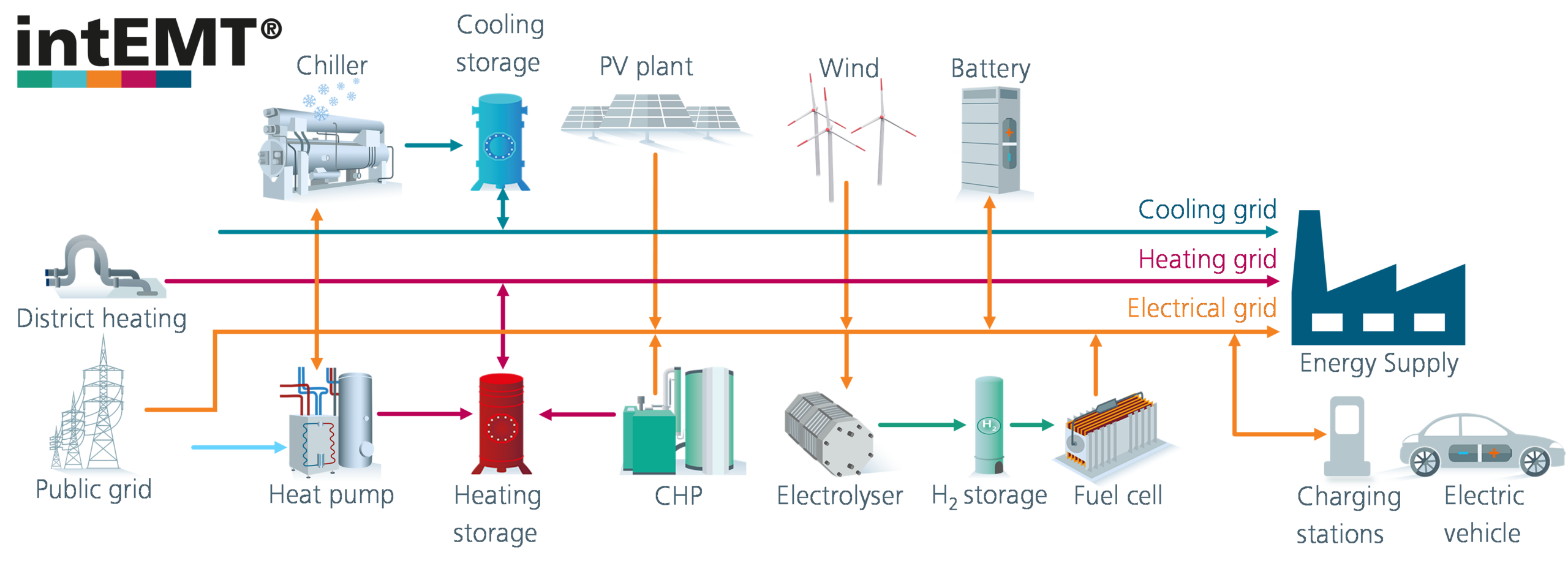
Various optimisation strategies are applied, which can be used individually or in combination. These include peak shaving using electrical and thermal systems and storage facilities, self-supply optimisation for the optimal use of local renewable energy, and day-ahead optimisation to optimise (quarter-)hourly energy trading. Overarching strategies, such as optimal charging management for battery- or fuel-cell-powered electric vehicles and holistic energy management for microgrids and island grids (stationary and mobile, e.g. for industrial and manufacturing sites, neighbourhood supply, hybrid ships and aircraft), complement the portfolio. This achieves cost savings, a reduction in emissions, and a resilient and reliable energy supply.
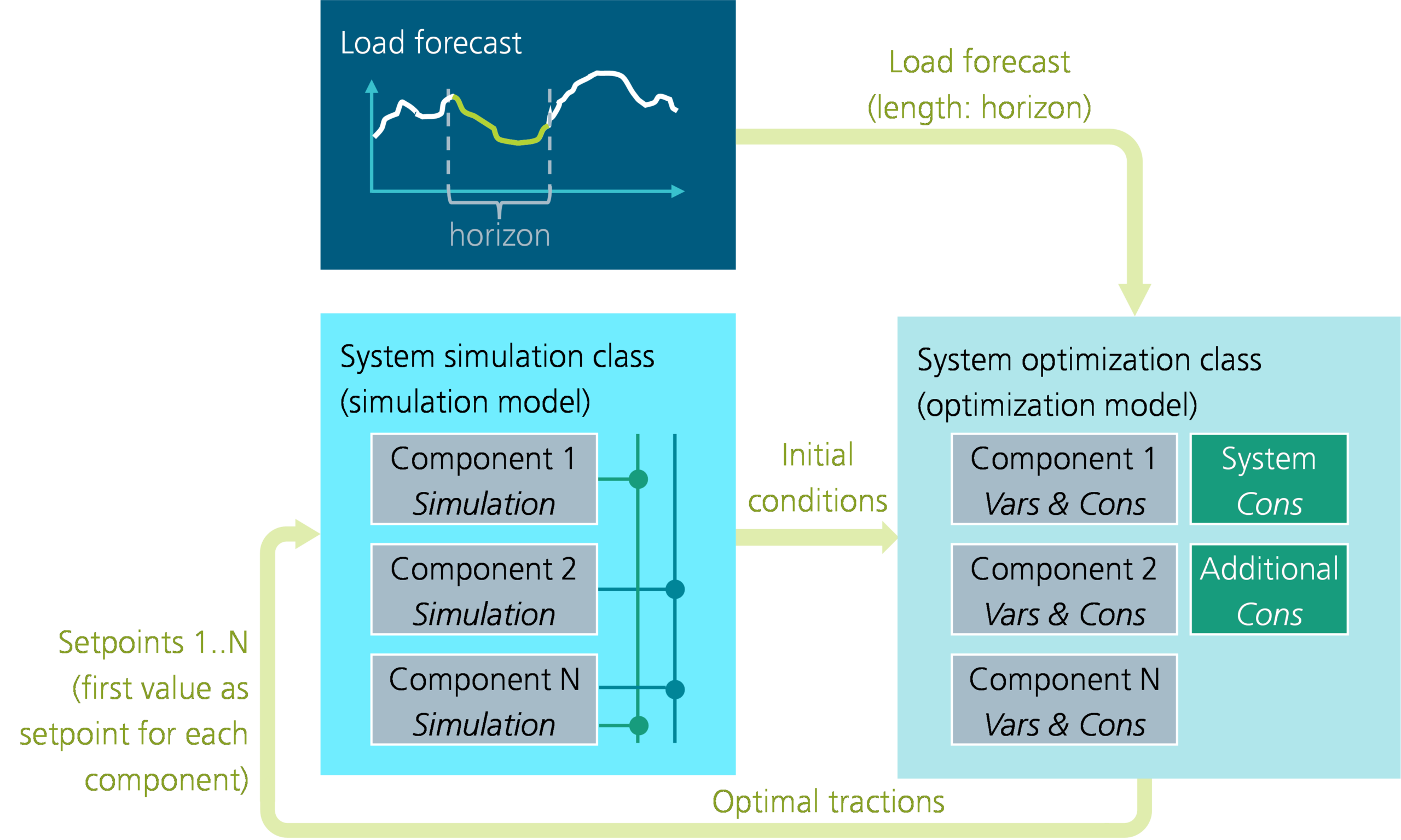
Implementation takes place, for example, using economic Model Predictive Control (eMPC) in several steps as shown in Figure 1: Based on a load forecast, a relevant section of the forecast (horizon) is passed on to the optimisation model. The model then calculates the optimal time profiles for the target values of the individual components, considering the components’ variables and constraints, system equations, and additional constraints, such as the maximum number of charging cycles for a storage unit. The first time-step of the results is passed to the simulation as a setpoint – in real-world operation, the plant controllers receive these specifications directly. The simulation then calculates the states, with the outputs, such as the state of charge of a storage unit, serving as initial conditions for the next iteration. In real-world applications, the measured values from the plant control systems are used for this purpose.
Further information about intEMT® is available on the website www.intemt.de .